Equality, Diversity and Inclusion (EDI) Policy
Introduction
Our Company is made up of brilliant people. Each of us is unique, whether in terms of our background, personal characteristics, experience, skills or motivations. And we value our people for the differences they bring to the table. These differences - this diversity - is powerful.
Fostering an inclusive culture helps each of us to benefit from a wider range of these different perspectives, experiences and skills. We believe that this creates a happier, more productive working environment for us all.
To support this inclusive culture, this policy:
This policy does not form part of your contract of employment and we reserve the right to amend or withdraw it at any time.
Scope
This policy applies to anyone working for us. This includes employees, workers, contractors, volunteers, interns and apprentices. The policy also relates to job applicants and is relevant to all stages of the employment relationship.
The policy accompanies our Anti-harassment and anti-bullying policy and any other equality, diversity and inclusion (EDI) policies adopted by the Company, for example Transgender equality policy, Menopause policy and Supporting religious observance at work policy.
Our Commitment to You
We believe that a culture of equality, diversity and inclusion not only benefits our Company but supports wellbeing and enables our people to work better because they can be themselves and feel that they belong.
We are committed to promoting a working environment based on dignity, trust and respect, and one that is free from discrimination, harassment, bullying or victimisation.
We ensure that our recruitment, promotion and retention procedures do not treat people less favourably because of their:
What We Expect From You
We expect you, and every one of our people, to take personal responsibility for observing, upholding, promoting and applying this policy. Our culture is made in the day-to-day working interactions between us so creating the right environment is a responsibility that we all share.
Cultivating this culture does not happen by accident but requires ongoing commitment and nurturing. The reality is that we live in a world where areas of difference (whether gender, sexual orientation, ethnicity or others) often translate to biases, challenges and barriers that may not be faced by others. And the more areas of difference a person brings, the more this effect can be compounded. In this way, the experiences of a black woman with a disability may be very different to the experiences of a black woman without a disability and also very different from the experiences of a white woman. This way of looking at diversity and inclusion is known as "intersectionality".
We expect you to treat your colleagues and third parties (including clients, suppliers, contractors, agency staff and consultants) fairly and with dignity, trust and respect. Sometimes, this may mean allowing for different views and viewpoints and making space for others to contribute.
By embedding such values and constructively challenging inappropriate comments or ways of working, you can help us achieve and maintain a truly inclusive workplace culture.
Any dealings that you have with colleagues or third parties must be free from any form of discrimination, harassment, victimisation or bullying.
If any of our people is found to have committed, authorised or condoned an act of discrimination, harassment, victimisation or bullying, we will take action against them including (for those to whom it applies) under our Disciplinary procedure.
You should be aware that you can be personally liable for discrimination and harassment.
Discrimination
The Equality Act 2010 prohibits discrimination because of certain protected characteristics. These are:
Discrimination can be intentional or unintentional and may occur directly, indirectly, by association, or by perception (see Different types of discrimination under the Equality Act 2010).
There are also two specific types of discrimination that apply only to disability: "discrimination arising from disability" and "failing to make reasonable adjustments" (see Different types of discrimination under the Equality Act 2010).
Discrimination is not always obvious and can be subtle and unconscious. This stems from a person's general assumptions about the abilities, interests and characteristics of a particular group that influences how they treat those people (known as "unconscious bias"). Such assumptions or prejudices may cause them to apply requirements or conditions that put those in particular groups at a disadvantage. Examples include:
Different Types of Discrimination Under the Equality Act 2010
- allocating some of the disabled person's duties to a colleague;
- changing their working hours or place of work;
- adjusting procedures for assessing job candidates; and
- modifying disciplinary and grievance procedures.
Harassment and Sexual Harassment
Harassment is unwanted conduct related to a protected characteristic that has the purpose or effect of:
Sexual harassment is:
You should refer to our Anti-harassment and anti-bullying policy for further information on our procedure for reporting harassment.
Victimisation
Victimisation is treating another person detrimentally either because that person has made a complaint of discrimination or harassment, or because they have supported someone else who has made such a complaint, for example by giving a witness statement that supports the allegations.
Bullying
There is no legal definition of bullying. However, we regard it as conduct that is offensive, intimidating, malicious, insulting, or an abuse or misuse of power, and usually persistent, that has the effect of undermining, humiliating or injuring the recipient.
Bullying can be physical, verbal or non-verbal conduct. It is not necessarily face to face and can be done by email, phone calls, online or on social media. Bullying may occur at work or outside work.
If the bullying relates to a person's protected characteristic, it may also constitute harassment and, therefore, will be unlawful (see Harassment).
You should refer to our Anti-harassment and anti-bullying policy for further information on our procedure for reporting bullying.
Equality of Opportunity
Recruitment
We take reasonable and appropriate steps to encourage job applications from as diverse a range of people as possible.
Anyone making a decision about recruitment must not discriminate in any way and must have attended appropriate diversity and inclusion training.
Every decision-maker should challenge themselves, and other members of the recruitment selection panel, to make sure that any stereotypes, unconscious bias or prejudice do not play any part in recruitment decisions.
Career Development
Any decision you make relating to a person's promotion or career development must be free from discrimination.
We ensure that selection criteria and processes for recruitment and promotion are reviewed on a regular basis so that there is no discriminatory impact on a certain group.
Disability Inclusion
Recruiting People With a Disability
The recruitment team will consider disability in advance of a recruitment campaign so that advertising, application forms and assessments, arrangements for interviews, job descriptions and employee specifications, and selection criteria are appropriate and as inclusive as possible.
We will ask applicants at the outset if they require any reasonable adjustments to be made to the recruitment process. These may include ensuring easy access to the premises for an interview/providing an alternative to a telephone interview for a deaf candidate or providing a suitable chair for an interview with a candidate suffering from back problems.
If you are involved in the interview process, you must not ask job applicants about their health or disability except with prior approval from HR. Such approval is given only in exceptional circumstances and where there are specific legal grounds for doing so.
Talking About Disability
We understand that some people find it hard to discuss their disabilities and that disability can be invisible.
Psychological safety, where people feel able to speak up about their experiences without fear of negative consequences, is paramount to ensuring disability inclusion.
However, this is only possible if we treat people with dignity, trust and respect and we expect everyone to uphold these values.
We do not tolerate ableist language in our Company. Ableist language is language that is negative, inappropriate or offensive towards people with a disability and may take the form of jokes or "banter". If you adopt such language, we will take action against you including (for those to whom it applies) under our Disciplinary procedure.
Reasonable Adjustments
If you have a disability, you do not have to tell us. However, we would encourage you to let us know so that we can support you, for example by making reasonable adjustments to our premises or to aspects of your role, or to our working practices.
If you are experiencing difficulties at work because of your disability, please contact your Head of Department or the People Team to discuss potential reasonable adjustments that may alleviate or minimise such difficulties. We may need to discuss your needs with you and your medical adviser to help us get the right support in place.
Training
If you are involved with making decisions about a person's employment, you must attend appropriate equality, diversity and inclusion training.
All new starters must attend equality, diversity and inclusion training as part of their onboarding programme.
Every current employee must attend regular equality, diversity and inclusion training.
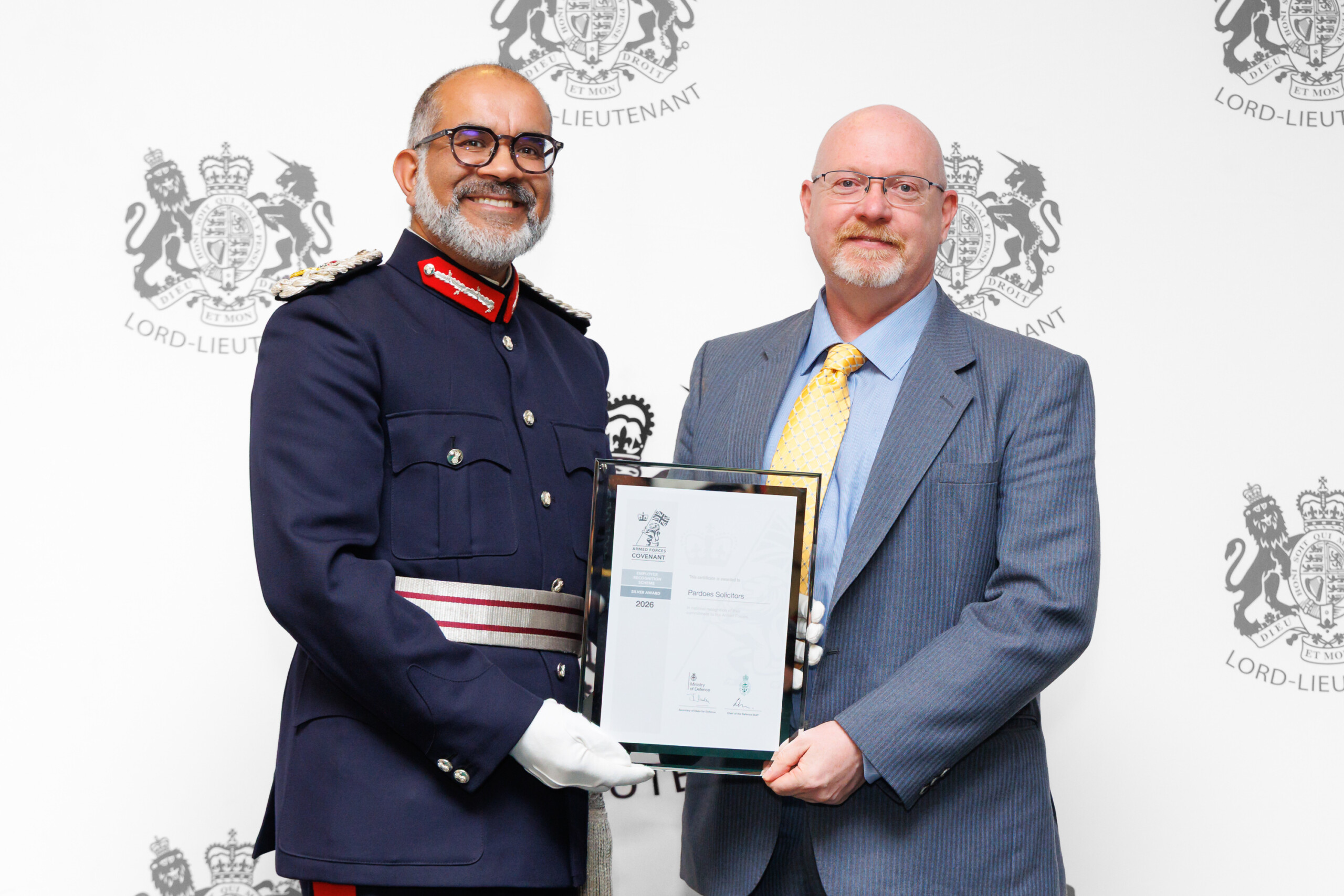
Pardoes Solicitors has been presented with the Defence Employer Recognition Scheme (ERS) Silver Award at a Lord Lieuten...

Join Our Expert Legal Team at Pardoes Solicitors Are you passionate about delivering expert legal advice and excepti...